
On this page20 sections

A dropshipping agent adds value when the brand needs local supplier discovery, quotation comparison, sample coordination, production follow-up, inspection, consolidation, and fulfillment to work as one managed process. Direct supplier management is better when the brand already knows the product and factory, has enough internal procurement capacity, and can control specifications, quality, payments, replenishment, and logistics without an intermediary. The right choice depends on coordination cost and control, not on whether an agent can quote a lower unit price.
The Decision Is About Capability, Not a Label
A supplier makes or provides the goods. An agent represents the buyer across one or more suppliers and may also coordinate warehousing and shipping. In practice, scopes vary. Some suppliers offer direct dropshipping. Some agents operate fulfillment centers. Compare the actual work, decision rights, records, and fees rather than assuming every provider with the same title behaves alike.
Where a Dropshipping Agent Adds Value
Finding and Comparing Suppliers
An agent is useful when a product brief must be converted into factory options. The work can include searching local marketplaces and supplier networks, checking whether a vendor can meet the specification, collecting comparable quotations, and arranging samples. This reduces the brand’s search burden, especially when product terminology, language, time zones, and local payment practices create friction. The brand should still approve the supplier, sample, and commercial commitment.
Coordinating Samples, Changes, and Production
New products rarely move from link to production without clarification. An agent can relay drawings, packaging requirements, color references, labels, and revision questions, then follow the purchase order through production. The value is not message forwarding. It is preserving one approved version and escalating deviations before inventory is completed. For a stable, repeat product with a mature factory relationship, this coordination layer may add little.
Inspecting and Consolidating Goods
When stock comes from several suppliers, an agent can receive goods into one location, verify quantities, perform agreed visual checks, quarantine exceptions, and consolidate inventory for fulfillment. The inspection plan must define sample size, checkpoints, evidence, and acceptance authority. Visual checks do not establish regulatory compliance or laboratory performance. The brand retains responsibility for approving the product and destination-market requirements.
Connecting Sourcing to Fulfillment
An integrated agent can reduce handoffs between purchase follow-up, receiving, inventory, packing, and shipment. That matters for small-batch tests, multiple SKUs, branded inserts, and frequent replenishment. PickoShip’s warehouse fulfillment scope includes receiving, agreed quality checks, inventory, order synchronization, pick and pack, dispatch, tracking, and returns handling. Exact eligibility, service targets, and special operations should be confirmed for each product.
When Direct Supplier Management Is Better
The Product and Supplier Are Already Proven
Direct management can work well when the product specification is stable, the factory has demonstrated consistent performance, and replenishment is predictable. The brand can communicate forecasts and changes without translation through another party. A direct relationship also gives the supplier clearer visibility into long-term demand, which can improve production planning when both sides share accurate information.
The Brand Has In-House Procurement and Quality Resources
Going direct does not remove the work. The brand must own supplier qualification, purchase orders, payment controls, sample approval, inspection planning, corrective action, shipment documents, and continuity planning. Direct management is attractive when an internal team can perform those tasks consistently and visit or audit suppliers when necessary. Without that capability, removing the agent may simply move hidden coordination cost into the brand.
Scale Makes Dedicated Supplier Work Economical
A large, concentrated purchase program may justify dedicated factory communication, negotiated production terms, tooling control, and formal supplier-development work. The calculation should use total landed and operating cost, not purchase price alone. Include employee time, sample and inspection expense, domestic transport, consolidation, defects, payment risk, and the cost of delayed decisions. Direct sourcing is not automatically factory pricing, and an agent fee is not automatically waste.
Agent or Direct: A Practical Comparison
| Decision Factor | Agent Model | Direct Supplier Model |
| Supplier search | Useful for discovery and comparison | Best when qualified suppliers are already known |
| Coordination | One contact across multiple vendors and handoffs | Brand communicates with each supplier |
| Control | Shared through written approvals and service scope | Direct, but requires internal process ownership |
| QC and receiving | Can coordinate agreed checks and consolidation | Brand appoints inspectors and manages disposition |
| Cost exposure | Agent, handling, and fulfillment fees | Internal labor, travel, inspection, logistics, and risk |
| Best fit | Complex, changing, or multi-supplier operations | Stable, concentrated, professionally managed sourcing |
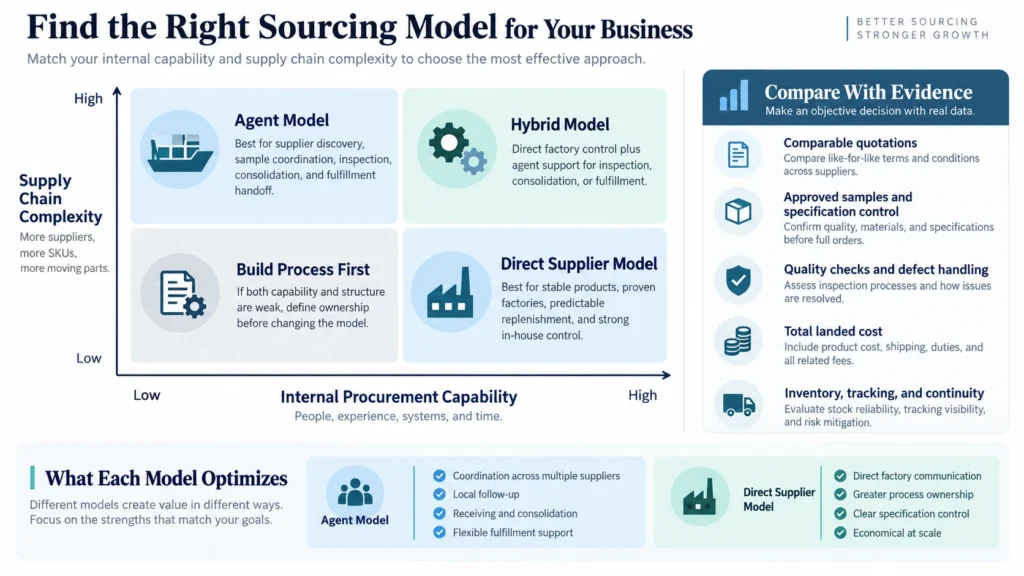
A Hybrid Model Often Works Best
The decision does not need to be permanent or all-or-nothing. A brand can manage strategic factories directly while using an agent for new-product discovery, overflow capacity, secondary suppliers, inspection, consolidation, or China-based fulfillment. Another option is to manage price and specification directly but authorize the agent to handle receiving, exceptions, and shipping. The operating agreement should identify who may contact the factory, approve changes, release payments, accept defects, and instruct the warehouse.
Signs the Agent Is Not Adding Enough Value
An agent should create more than convenience. Reconsider the arrangement if quotations cannot be compared on the same specification, supplier identities or commercial terms are unnecessarily hidden, changes proceed without approval, QC evidence is inconsistent, fees are unclear, or recurring defects never produce corrective action. Another warning is dependence on one chat thread with no shared order, inventory, or exception record. These gaps make performance difficult to audit and can erase the benefit of local coordination.
Before moving direct, confirm that the brand can replace each missing function. Assign owners for supplier qualification, purchase orders, payment authorization, sample and specification control, inspections, domestic collection, export documents, fulfillment handoff, and backup supply. If these responsibilities remain unassigned, changing the commercial relationship will not solve the operating problem.
How to Compare the Two Models With Evidence
Pilot both models on a representative SKU or purchase cycle. Use the same approved specification and compare the full process:
- Time from request to comparable quotation and approved sample.
- Total landed cost, including coordination, inspection, domestic transport, fulfillment, and exceptions.
- Quality evidence, defect disposition, and speed of corrective action.
- Inventory visibility, order integration, tracking, and responsibility at each handoff.
- Continuity when a supplier, employee, agent contact, route, or warehouse is unavailable.
Use a structured fulfillment-partner checklist for operational due diligence. If the model includes brand customization, confirm approval and version controls for the private-label workflow. Review PickoShip’s supplier comparison guide as complementary context, not as a substitute for product-specific qualification.
Conclusion
A dropshipping agent earns its place by removing real coordination risk and producing useful evidence across suppliers, quality checks, inventory, and fulfillment. Direct supplier management is better when the brand has a proven supply base and the people, process, and volume to manage it professionally. Compare total operating work, control, and failure cost. A hybrid model is often the most practical transition as products mature.
FAQs
Does using an agent mean losing supplier control?
No. The brand can retain supplier approval, specifications, pricing authority, and purchase decisions while delegating coordination and execution through a written scope.
Is buying directly from a factory always cheaper?
Not necessarily. Compare total landed cost and internal workload, including inspection, domestic transport, consolidation, defects, payments, and exception handling.
When should a brand move from an agent to direct management?
Consider it when the product, factory, demand, and specification are stable and an internal team can manage procurement, quality, logistics, and continuity without service gaps.
Can an agent and a direct supplier work together?
Yes. The brand may negotiate directly while the agent handles local receiving, agreed inspection, consolidation, warehousing, fulfillment, or shipping coordination.
To compare models for your product, share the specification, supplier count, order pattern, inspection needs, packaging, destinations, and current handoffs, then request a written PickoShip sourcing and fulfillment review before changing the supply chain.
Need numbers for your route?
Turn the research into a fulfillment plan.
Share your products, target markets, monthly order volume, and delivery target. We will identify which sourcing, inventory, and fulfillment questions need a verified quote.
No commitment. Route availability, pricing, and delivery times are confirmed in a written quote.