
On this page18 sections

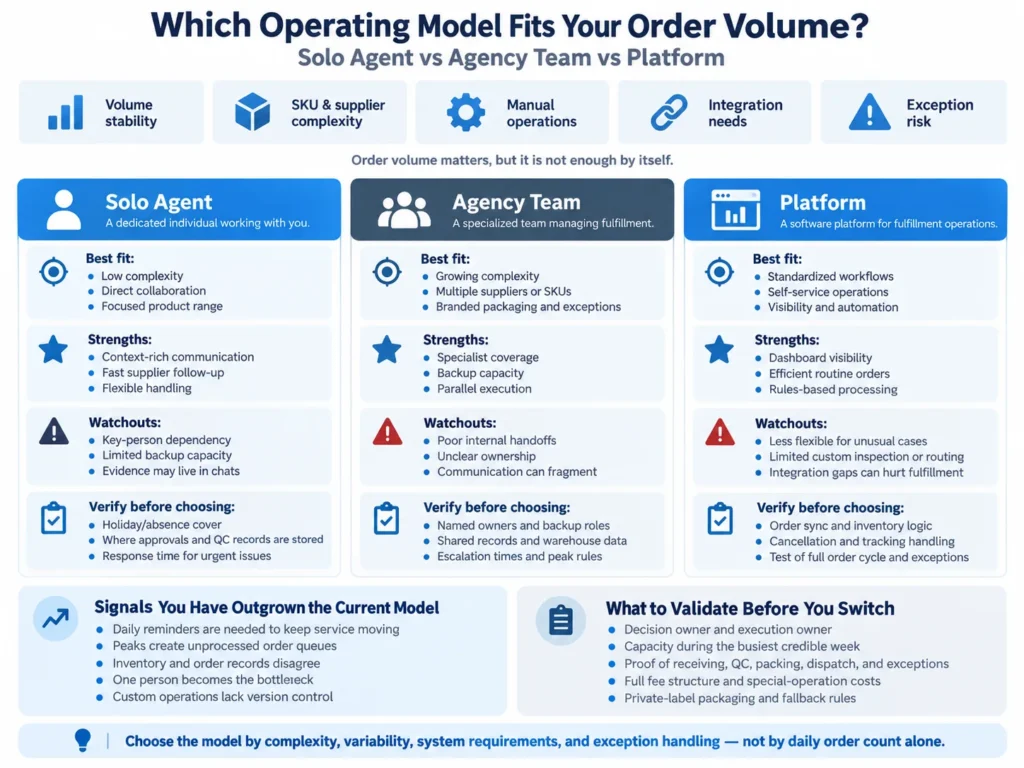
A solo dropshipping agent fits a business that values direct communication and has manageable sourcing and fulfillment complexity. An agency team fits a growing brand that needs specialist coverage, backup capacity, and structured exception handling. A platform fits standardized operations that benefit from self-service tools, catalog access, and automation. Order volume matters, but it is not a reliable cutoff by itself. The right operating model depends on volume variability, SKU and supplier complexity, customization, integration needs, and the cost of a missed handoff.
What Each Operating Model Actually Means
The market uses agent, agency, and platform loosely. Evaluate the operating design behind the label: who performs the work, who provides backup, how orders enter the system, and where evidence is stored.
Solo Dropshipping Agent
A solo agent is one primary operator coordinating suppliers, quotations, samples, purchasing, inspection, packing, and shipping, sometimes through outside warehouses. The model can provide context-rich communication because one person knows the history. Its main constraint is concentration risk. Response time, supplier follow-up, and exception resolution may all depend on the same person’s availability and operating discipline.
Agency Team
An agency team divides work among account management, sourcing, purchasing, quality control, warehouse operations, and logistics. The client may still have one dedicated contact, but execution does not depend on that person alone. This model can handle more suppliers, SKUs, special projects, and exceptions, provided the team uses shared records and clear ownership rather than informal message chains.
Dropshipping Platform
A platform is software-led. Sellers typically select products or submit sourcing requests, connect a store, fund orders, and monitor fulfillment through a dashboard. Standardized workflows can make routine orders efficient and visible. The tradeoff is less flexibility when products require unusual inspection, custom packaging, supplier negotiation, restricted-goods routing, or a decision outside the platform’s normal process. Some platforms add human agents, so verify the actual service boundary.
Hybrid models are common. A provider may present a platform interface while assigning a dedicated account contact and using a team for sourcing, quality control, and warehouse execution. Another may market itself as an agency while relying on third-party systems and warehouses. Classify the model by control, staffing, records, and escalation coverage. The commercial label should not replace operational due diligence.
Volume Is More Than Daily Order Count
Average orders per day describe workload, not operating difficulty. A stable single-SKU store can be easier to support than a lower-volume catalog with many variants, suppliers, bundles, and destination rules. Evaluate five dimensions together:
- Baseline volume and peak-to-average ratio, including campaign or viral spikes.
- SKU, variant, supplier, and destination count.
- Inspection, kitting, inserts, private label, or other manual operations per order.
- Store integrations, order-edit cutoffs, tracking updates, and inventory visibility.
- Exception frequency and the business impact of delayed answers or incorrect dispatch.
Use recent order data and upcoming campaign plans rather than a single best month. Capacity should be tested against the busiest credible week, not only the average.
Operating Model Comparison
| Decision Factor | Solo Agent | Agency Team | Platform |
| Best fit | Low complexity, direct collaboration | Growing complexity and managed execution | Standardized, automation-led workflows |
| Coverage | Depends on one person’s availability | Specialists and backup ownership | System availability plus defined support |
| Flexibility | High when the agent has access and authority | High with documented custom workflows | Strong inside standard process boundaries |
| Visibility | Messages and agent-provided reports | Shared records, account contact, warehouse data | Dashboard, order status, and rules |
| Main risk | Key-person dependency | Poor internal handoffs | Rigid handling of nonstandard cases |
When a Solo Agent Is the Better Fit
Choose a solo agent when the product range is focused, the workflow is understandable by one operator, and direct access materially improves sourcing or supplier communication. Confirm who covers holidays, illness, warehouse cutoffs, and urgent carrier cases. Ask where specifications, approvals, QC evidence, and order changes are stored. If the answer is only a personal chat history, the model is not ready for business-critical volume.
When an Agency Team Is the Better Fit
An agency team becomes useful when sourcing, quality control, branded packaging, inventory, and shipping require parallel work. It also fits stores with volatile peaks or multiple sales channels because responsibilities can be distributed. Team size alone proves nothing. Request named owners, backup roles, escalation times, warehouse capacity rules, and a consistent operating record. A dedicated contact should simplify communication without becoming a single point of execution failure.
When a Platform Is the Better Fit
Choose a platform when products and workflows are standardized and the seller prefers speed, visibility, and self-service control. Review supported store connections, order sync frequency, inventory logic, cancellation handling, and tracking return. A platform’s integration coverage matters more than the number of dashboard features. Test the full order cycle, including address changes, split shipments, stockouts, and refunds, before routing all live orders through it.
Signals That You Have Outgrown the Current Model
Move to a more structured model when service quality depends on daily reminders, peaks create unprocessed queues, inventory and order records disagree, supplier issues wait for one person, or custom operations lack version control. Another warning is invisible capacity: the provider accepts growth but cannot show staffing, warehouse workflow, system controls, or escalation ownership. These signals matter more than reaching an arbitrary order threshold.
How to Validate Fit Before You Switch
Run a limited pilot that represents normal orders and difficult cases. Share SKU data, product attributes, expected peaks, inspection rules, packaging versions, destinations, and sales channels. Then evaluate:
- Response ownership: who decides, who executes, and who covers an absence?
- Capacity evidence: what changes during a spike, and which orders receive priority?
- Operational proof: can the provider return receiving, QC, inventory, packing, dispatch, and exception records?
- Commercial clarity: which sourcing, handling, storage, shipping, customization, and exception fees apply?
Use a structured fulfillment-partner checklist and confirm the provider’s warehouse fulfillment scope. If branding is planned, validate minimum quantities, component storage, change approval, and fallback packaging within the private-label workflow.
Where PickoShip Fits
PickoShip can be evaluated as a managed agency-team model supported by fulfillment systems: clients have a dedicated contact while sourcing, supplier coordination, agreed quality checks, warehouse operations, order synchronization, packing, dispatch, and tracking involve wider operational functions. Exact service scope, processing targets, special operations, and capacity for a peak should be confirmed in writing for the specific SKU mix and destinations.
Conclusion
A solo dropshipping agent, agency team, and platform can each be the right choice. Match the model to operational complexity, peak exposure, customization, system requirements, and exception risk rather than daily volume alone. The best fit is the model that can execute the difficult week, preserve evidence, and maintain clear ownership as the store grows.
FAQs
How many orders per day justify an agency team?
There is no universal threshold. A team becomes useful when peaks, SKU count, suppliers, custom operations, or exceptions exceed the reliable capacity of one operator.
Is a private dropshipping agent always a solo agent?
No. Private agent may describe dedicated service, while fulfillment is performed by a wider sourcing, warehouse, and logistics team. Confirm the operating structure.
Can a platform support high order volume?
Yes, when the workflow is standardized and system, warehouse, carrier, and support capacity are proven. Test peak and exception cases rather than relying on dashboard claims.
Should a growing store switch providers before a major campaign?
Avoid an untested full migration. Pilot representative SKUs and exception cases, reconcile inventory and tracking, then expand after the new workflow is stable.
To assess fit, share your SKU count, suppliers, average and peak orders, destinations, packaging steps, and store integrations, then request a written PickoShip capacity review before moving live volume.
Need numbers for your route?
Turn the research into a fulfillment plan.
Share your products, target markets, monthly order volume, and delivery target. We will identify which sourcing, inventory, and fulfillment questions need a verified quote.
No commitment. Route availability, pricing, and delivery times are confirmed in a written quote.