On this page14 sections

A China dropshipping agent should treat a marketplace listing as a clue, not as the supply chain. The useful work begins by translating that listing into a product brief, searching several supply channels, and asking each candidate to quote the same commercial conditions. The result should be a short list of genuinely comparable options: one may be quickest for a small test, another may provide better control at volume, and a third may support customization.
One listing is a reference not a sourcing brief
A listing rarely tells a buyer everything that determines cost or quality. The headline may hide a material change between variants, while the photo may show accessories that are not included. A low displayed price may apply to an incomplete version, a large quantity tier, or domestic delivery only.
The agent first separates visible facts from assumptions. The product brief should record the exact variant, dimensions, materials, functions, included parts, finish, packaging, labeling, and any feature that must not change. It should also identify negotiable details. If the seller can accept a different color but not a weaker material, candidates need to know that before they quote.
Reference photos and links remain useful, but the brief becomes the comparison standard. Unconfirmed details should be marked for sample verification rather than treated as fact.
Search the supply network in layers
For product sourcing from China, the public listing is only one entry point. An agent can use the product name, image, specifications, Chinese terminology, category knowledge, and supplier relationships to search several parts of the market while keeping the requirement constant.
Typical search layers include domestic marketplaces, wholesale markets, category focused trading companies, direct manufacturers, and referrals from established supplier networks. A brand that needs a broad starting map can use this guide to finding reliable dropshipping suppliers before moving into the deeper comparison process described here.
| Supply path | Cost effect | Speed effect | Control effect |
| Public marketplace listing | Easy price reference but may include reseller margin or incomplete scope | Fastest route to a test purchase | Limited visibility beyond the listed offer |
| Domestic supplier or wholesale source | May expose lower base prices but adds local purchasing and transport work | Often quick for stocked goods | More room to confirm variants and packaging |
| Direct manufacturer | Can improve unit economics at suitable volume but may add MOQ tooling or setup costs | Slower when production or samples are required | Greater control over specification and repeat production |
| Trading company or consolidator | Unit price may be higher in exchange for coordination and mixed product access | Can shorten multi SKU sourcing | One commercial contact but less direct production visibility |
The right path depends on test quantity, expected reorder volume, customization, quality risk, and how inventory will enter fulfillment.
Make every supplier quote answer the same question
Supplier comparison fails when each candidate receives a different request. One quote may cover a sample, another a carton, and another a production batch; packaging and transport may also be treated differently. The commercial scope is not comparable.
An agent should issue a normalized request for quotation. It should specify the approved product brief, sample quantity, initial stock quantity, expected repeat quantity, packaging, inspection requirements, delivery point in China, and who pays domestic freight. For dropshipping, it should also state whether the supplier must dispatch individual orders or send finished inventory to a fulfillment warehouse.
The comparison should separate product price, setup or tooling, packaging, domestic transport, purchasing fees, and inspection. International shipping can then be modeled from the packed product and destination. The lowest listing price may still produce a higher landed cost once weight, packaging, defects, and handling are included.
Separate identical photos from equivalent supply
Two listings can use the same photograph without representing the same product or source. One seller may hold stock, another may buy only after receiving an order, and a third may offer a visually similar version with different materials. The agent must prove equivalence instead of assuming it.
Useful checks include current product photos or video, a completed specification sheet, the supplier’s legal and payment identity, clarification of its production role, and samples from the final candidates. Check each sample against the must match features in the brief.
Local context also matters. Location, category focus, response quality, and access to replacement components can change repeat order risk. PickoShip describes a Shenzhen based team that coordinates sourcing, samples, quality checks, storage, packing, and dispatch within its sourcing and operating model. The precise scope still needs written confirmation for each product.
Let fulfillment requirements filter candidates early
A source is not useful if it cannot connect to the intended operating model. Before recommending a supplier, the agent should check how goods will move from production or local stock into customer fulfillment. A factory that does not ship single parcels may still be suitable if it can send a controlled batch to a China warehouse. A marketplace seller may be convenient for tests but unsuitable for repeat inventory or custom packaging.
The evaluation should cover SKU and variant labeling, carton identification, replenishment timing, packaging, inspection access, defect handling, and the handoff point for domestic freight. Product attributes and destinations may affect available shipping routes, so review the selected version before committing to inventory.
PickoShip’s published China fulfillment workflow connects supplier inbound receiving with agreed quality checks, SKU level storage, packing, and cross border dispatch. Eligibility, special checks, product restrictions, service levels, and fees are conditional and should be documented in the operating plan.
Build a recommendation not a pile of URLs
The agent’s output should make the tradeoffs visible. A practical comparison file records business identity, source type, confirmed specification, sample status, quote assumptions, minimum quantities, packaging, domestic delivery, replenishment conditions, open questions, and the responsible contact. It should distinguish verified facts from statements that still require evidence.
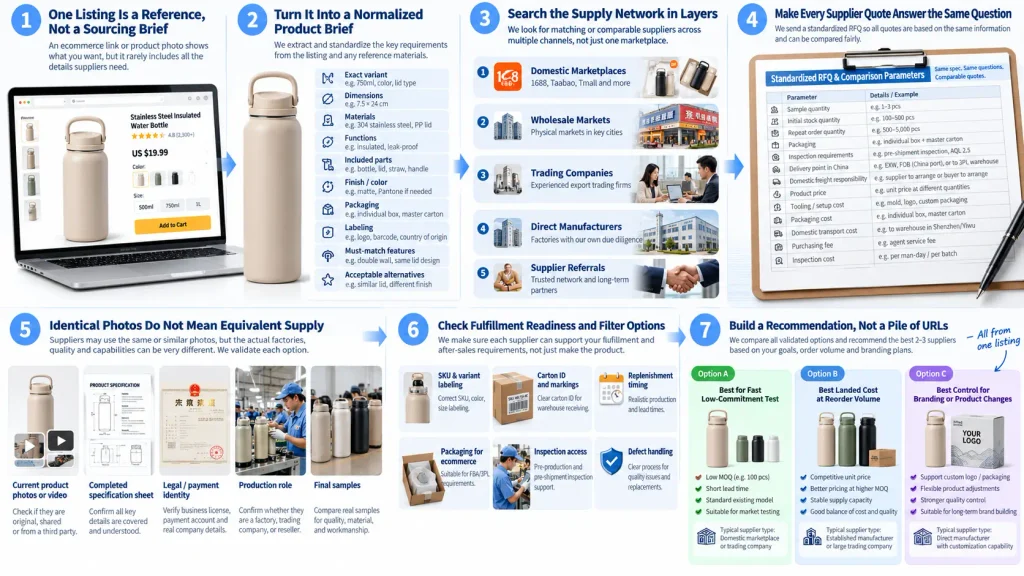
The final recommendation can present three roles rather than declaring one universal winner. Option A may be best for a fast low commitment test. Option B may offer the strongest landed cost at the expected reorder quantity. Option C may provide the best control for branding or product changes. A brand can then choose based on its current stage and keep a backup option without pretending that price alone settles the decision.
What to send before the search starts
A better input produces a better supplier search. Send the agent:
- The exact product link plus clear photos or video
- Must match features and acceptable alternatives
- Target selling countries and expected order volume
- Sample quantity initial stock quantity and reorder assumptions
- Neutral or branded packaging requirements
- Any known product restrictions or documentation needs
- The target landed cost or retail economics if available
- The deadline for testing and the conditions for scaling
Do not hide uncertainty. If sales volume is unknown, state that the project is a test and ask for staged options. If the reference listing may be inaccurate, identify which details require confirmation. This allows the agent to search broadly without comparing products that solve different briefs.
Conclusion
Finding supply beyond one marketplace listing is not a matter of copying an image into more search boxes. A China dropshipping agent creates value by converting the listing into a controlled brief, reaching multiple parts of the local supply network, normalizing quotes, verifying samples, and connecting the chosen source to fulfillment. The best result is not necessarily the cheapest candidate. It is the option whose cost, speed, quality evidence, and operating responsibilities fit the brand’s next stage.
Frequently asked questions
Can an agent always find the exact product from a listing?
No. Photos may be reused, listings may be outdated, and some details may be exclusive to one seller. An agent can search for matching or equivalent options, but the final match should be confirmed through specifications and samples.
How many supplier options should an agent compare?
There is no fixed number. A short list of three materially different and qualified options is often more useful than ten unverified links. The goal is enough coverage to reveal tradeoffs and provide a credible backup.
Is the lowest supplier quote usually the best option?
Not necessarily. Compare the same specification and include packaging, domestic transport, inspection, handling, defect risk, and international fulfillment. A low product price can become expensive when other requirements are added.
Can an agent work with a supplier the brand already found?
Yes, if the supplier and operating scope can be confirmed. The agent can help clarify purchasing terms, receive stock, perform agreed checks, and coordinate fulfillment while also identifying alternatives where a backup source is useful.
Next step
To assess realistic alternatives, send PickoShip the product link or photos with the must match features, destination countries, test quantity, expected order volume, and packaging requirements. The team can confirm whether the product and requested sourcing to fulfillment scope are suitable for a written quotation.
Need numbers for your route?
Turn the research into a fulfillment plan.
Share your products, target markets, monthly order volume, and delivery target. We will identify which sourcing, inventory, and fulfillment questions need a verified quote.
No commitment. Route availability, pricing, and delivery times are confirmed in a written quote.