On this page14 sections
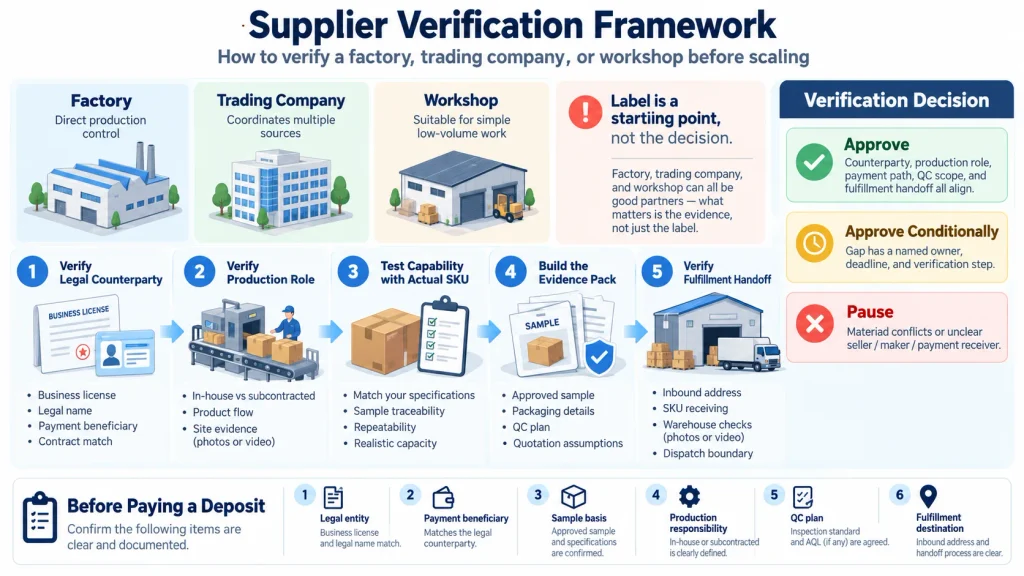
A China dropshipping agent should not judge a supplier from the label “factory,” “trading company,” or “workshop.” The useful question is what the business actually controls. Before sample approval or payment, verify the legal counterparty, production role, capability, quality controls, capacity, payment details, and fulfillment handoff.
Each type can work. A factory may control production but lack flexible order handling. A trading company may coordinate several sources but offer less production visibility. A workshop may suit simple, low-volume work while depending on outside processes. The real risk is an undocumented chain with no clear owner for specifications, defects, repeat orders, or dispatch.
Supplier type is a starting hypothesis, not a verdict
Marketplace badges, product photos, and sales conversations describe how a supplier wants to be seen. They do not prove who owns equipment, purchases materials, performs finishing, or authorizes rework. Even a genuine manufacturer may outsource coating, printing, assembly, or packaging.
For dropshipping, the supplier’s production identity is only half the decision. The operating model must also explain where approved stock goes, who counts and checks it, how individual orders are packed, and who handles discrepancies. A strong product source may still need a separate warehouse and fulfillment operation. A practical starting point is the broader guide to finding reliable dropshipping suppliers; the verification below begins after a candidate reaches the shortlist.
| Supplier model | Possible operating strength | Main verification risk | What control must be documented |
| Factory | Direct access to a defined production process and technical staff | “Factory” claim may cover only assembly or one outsourced stage | Product scope, owned processes, subcontractors, capacity, and change approval |
| Trading company | Supplier comparison, communication, mixed-SKU purchasing, and coordination | Actual producer or margin structure may be unclear | Named production source, inspection rights, specification flow, and replacement responsibility |
| Workshop | Flexible communication and small-run work for suitable products | Informal records, limited equipment, or unstable outside processing | Legal seller, process limits, batch records, backup plan, and fulfillment handoff |
The table is not a ranking. The best fit depends on the SKU, order pattern, customization, defect risk, and the level of visibility the brand needs.
Verify the legal business and commercial counterparty
The agent should begin by matching the company behind the quotation to the company that will receive payment and appear on commercial documents. Request the current business license and record the registered name, unified social credit code, address, legal representative, establishment status, and business scope. Differences are not automatically disqualifying, but they need a written explanation.
Compare the legal name across the quotation, invoice, contract, bank beneficiary, and supplier communication. If payment goes to a trading company, export company, related business, or personal account, document the relationship and the party responsible for the goods before paying.
Registration confirms that an entity exists; it does not prove that it makes the product, owns the site, or can meet the order. Legal verification and operating verification are separate tasks.
Verify who performs each production step
Instead of asking only “Are you a factory?”, ask the supplier to map the product flow: material purchasing, molding or cutting, machining, printing, assembly, testing, packing, and storage. Mark each step as in-house, subcontracted, or supplied as a finished component. Then identify who approves a subcontractor and who owns a defect found after that stage.
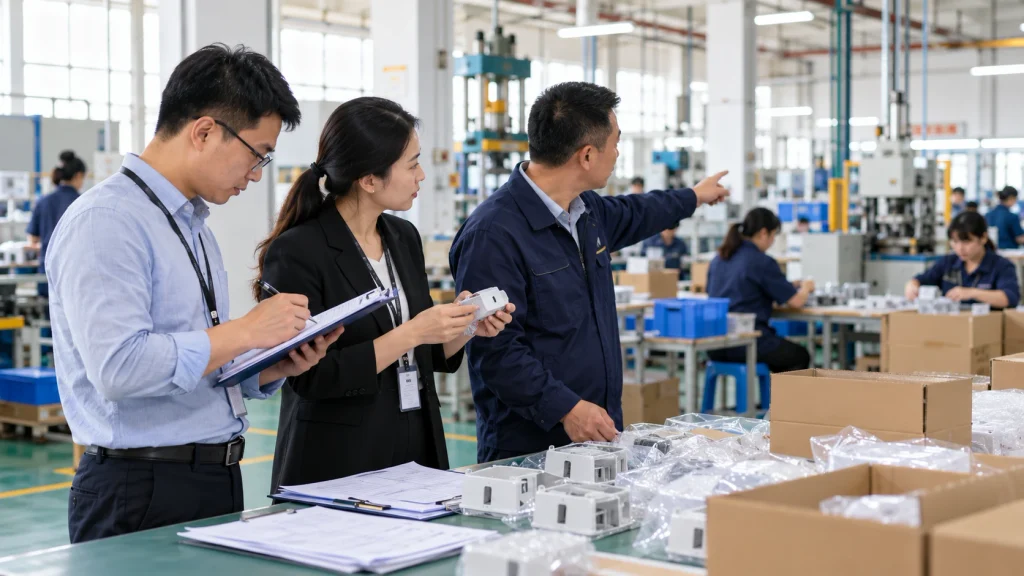
On-site evidence should connect the exact SKU to the claimed process. Check current records, matching work-in-progress, relevant tools, material labels, retained samples, and staff who can answer product-specific questions. A showroom tour or unrelated equipment proves little. If a workshop only assembles, the upstream component source and its repeatability also matter.
The aim is traceability, not catching a supplier using partners. Outsourcing can be normal. Undisclosed outsourcing is the problem because it hides lead-time, quality, and change-control risks.
Test capability with the actual product brief
A general factory audit can miss the issue that determines whether one SKU succeeds. Give every candidate the same controlled brief: drawings or reference sample, dimensions, materials, functions, variants, tolerances where applicable, labeling, packaging, destination markets, and expected order pattern. Ask the supplier to identify unclear or unachievable points before quoting.
Compare evidence against the brief. Can the technical contact explain materials and critical dimensions? Can the supplier repeat the requested finish? Are tests relevant to the product? Identify requirements needing new tooling, outside processing, certification review, or a packaging trial. Treat claims as conditional until the sample and production plan support them.
A sample is necessary but insufficient. Record who made it, when it was made, which materials and process were used, and whether the production batch will follow the same route. A hand-finished “golden sample” that cannot be repeated at volume is not a reliable control standard.
Build an evidence pack before scaling
The agent should turn observations into a compact evidence pack that the brand can review. It should include the legal seller, production-site identity, product-flow map, approved specification, dated sample photos, packaging details, quotation assumptions, planned checks, exception owner, and fulfillment destination. Photos should show context and identifiers, not just attractive close-ups.
For a pilot batch, define acceptance criteria before production. At minimum, record quantity, visible condition, key measurements or functions, variant mix, labeling, packed dimensions, and carton information. When defects appear, the record should show who decides on rework, replacement, credit, or acceptance. Repeat-order control improves when the same evidence can be compared across batches.
Capacity needs a reality check. Ask about normal output for the product family, current load, bottlenecks, material lead time, and peak plans. A workshop may suit steady modest volume; a larger factory may be a poor fit if the order receives low priority. Verify capacity against the SKU and schedule.
Verify the dropshipping and fulfillment handoff
A producer does not need to dispatch individual consumer parcels if a fulfillment partner receives finished stock. What matters is a documented boundary between production and fulfillment. Confirm the inbound address, carton labels, SKU identification, advance shipment information, receiving count, agreed inspections, inventory release, and the owner of discrepancies.
Separate factory lead time, domestic transfer, warehouse processing, and cross-border transit. One vague delivery promise makes delays difficult to diagnose. If the supplier handles dropshipping, test individual-order processing, packing, valid tracking, customer-data protection, and wrong-item or damage handling.
PickoShip describes a Shenzhen-based sourcing and fulfillment operation that coordinates sourcing, agreed checks, storage, packing, and global dispatch. Its sourcing and operating model and China fulfillment workflow can be reviewed when a brand wants the factory-to-warehouse handoff managed within one operating plan. Exact scope, product eligibility, checks, fees, and route conditions should be confirmed in writing.
Use a verification decision, not a supplier label
After the checks, classify the candidate by evidence and fit. Approve only when the legal counterparty, production role, product plan, payment path, QC scope, and fulfillment handoff are consistent. Approve conditionally when a manageable gap has a named owner, deadline, and verification step. Pause when material evidence conflicts or the supplier refuses to clarify who makes, sells, or receives payment for the goods.
A trading company can be the right choice for a multi-SKU assortment. A focused workshop can be suitable for a controlled simple product. A factory can be preferable for custom development or repeat technical work. The buyer retains control by documenting the chain, not by demanding one supplier label in every situation.
Conclusion
Factory, trading company, and workshop are useful descriptions, but none is a quality guarantee. A China dropshipping agent adds value by proving who the counterparty is, where the product is made, which steps are outsourced, whether the approved sample can be repeated, how defects are handled, and how finished stock reaches the fulfillment operation.
The decision should rest on evidence tied to the actual SKU and order model. When legal identity, production responsibility, payment, quality, and fulfillment agree, the brand can scale with clearer cost, timing, and accountability.
Frequently asked questions
Is a factory always better than a trading company for dropshipping?
No. A factory may offer direct production access, while a trading company may coordinate multiple suppliers and categories more effectively. Compare product fit, transparency, quality control, and fulfillment responsibility.
How can an agent tell whether a supplier really manufactures the product?
Match the business scope and site to product-specific evidence: relevant processes, work-in-progress, tools, records, technical answers, and a traceable sample. One signal alone is not enough.
Can a small workshop be a reliable supplier?
Yes, for an appropriate product and volume, if its legal seller, process limits, outside suppliers, batch controls, capacity, and backup plan are documented and tested.
What should be verified before paying a deposit?
Verify the legal entity, payment beneficiary, product specification, sample basis, production role, price assumptions, delivery terms, QC plan, defect remedy, and destination for finished goods.
Next step
To request a supplier and fulfillment fit review, share the product link or photos with PickoShip together with the required variants, expected volume, destination countries, packaging needs, current supplier information, and any sample or inspection records.
Need numbers for your route?
Turn the research into a fulfillment plan.
Share your products, target markets, monthly order volume, and delivery target. We will identify which sourcing, inventory, and fulfillment questions need a verified quote.
No commitment. Route availability, pricing, and delivery times are confirmed in a written quote.